
Introduction
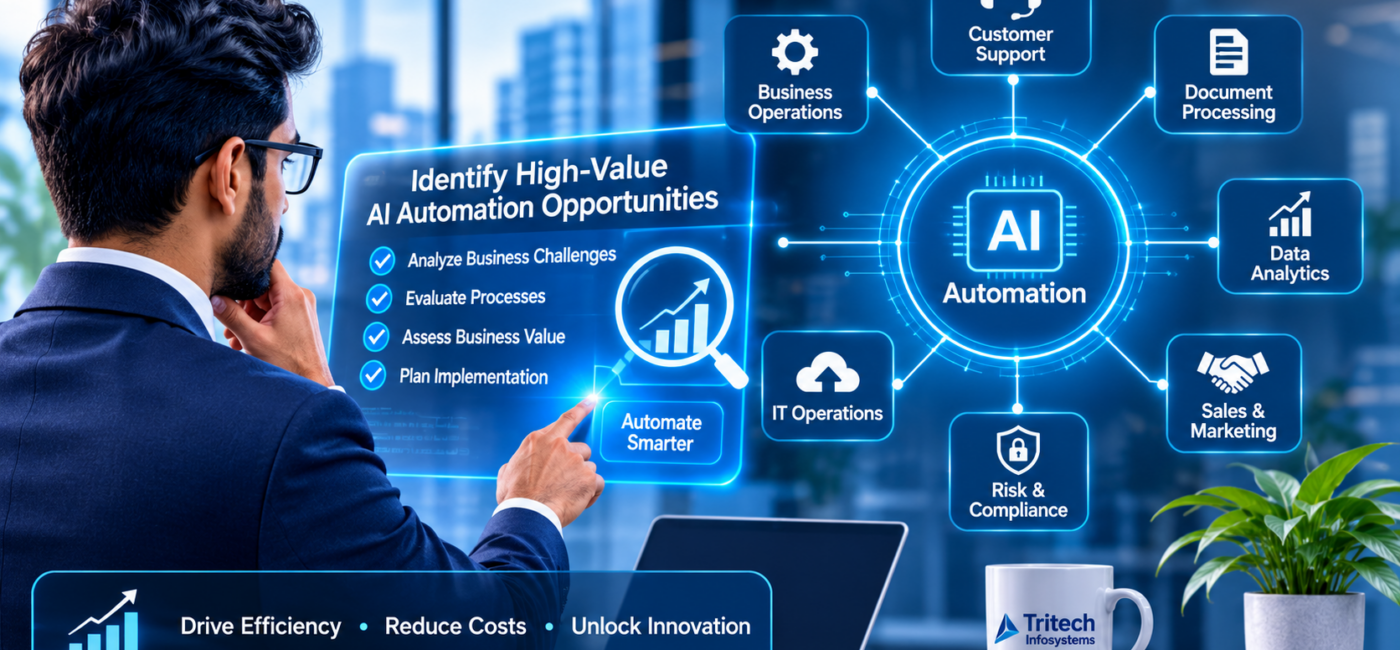
Enterprise automation is no longer limited to simple repetitive tasks. With advancements in Artificial Intelligence, organizations can now improve complex business workflows, support decision-making, and connect multiple enterprise systems through intelligent automation.
However, successful AI automation does not begin with selecting a tool or implementing a new technology. It begins with identifying the right business opportunities.
Enterprises need to understand where automation can create meaningful value, reduce operational complexity, and improve business performance.
In this article, we explore how organizations can identify high-value AI automation opportunities and build a practical approach to enterprise AI adoption.
1. Start with Business Challenges, Not Technology
One of the most common mistakes in automation initiatives is starting with technology instead of business needs.
Before selecting an AI platform or automation solution, organizations should identify the operational challenges they want to address.
Some common areas include:
- Repetitive manual processes that consume employee time.
- Delays in processing business documents and requests.
- Fragmented information across multiple enterprise systems.
- Slow customer support and internal service workflows.
- Difficulty accessing and analyzing business information.
- Manual coordination between departments and applications.
Understanding these challenges helps organizations identify where AI can deliver practical business value.
2. Identify Processes with High Automation Potential
Not every business process requires AI automation. The most suitable opportunities are often workflows that involve repetitive activities, structured information, multiple systems, or frequent decision-support requirements.
Enterprises can evaluate processes based on the following characteristics:
High-volume activities: Processes involving large numbers of repetitive requests or transactions.
Time-consuming workflows: Activities that require significant manual effort or repeated information gathering.
Data-intensive operations: Workflows that involve reviewing documents, extracting information, or analyzing business data.
Multi-system processes: Tasks that require information exchange between different enterprise applications.
Knowledge-dependent activities: Processes where employees regularly search through documents, policies, and internal knowledge repositories.
These characteristics can help organizations prioritize workflows for further assessment.
3. Evaluate Business Value and Implementation Feasibility
Identifying an automation opportunity is only the first step. Enterprises must also determine whether implementing it is worthwhile and technically feasible.
A practical evaluation should consider:
- Business impact: How will automation improve operational efficiency, service quality, or decision-making?
- Time savings: How much manual effort could potentially be reduced?
- Process complexity: Are the workflow steps and business rules clearly understood?
- Data availability: Is the required information accessible, accurate, and reliable?
- Integration requirements: Can the solution connect with existing enterprise systems?
- Risk and governance: What security, compliance, and approval controls are required?
Evaluating these factors helps organizations avoid investing in automation initiatives that are difficult to implement or offer limited business value.
4. Understand Where AI and Traditional Automation Fit
Not every automation opportunity needs Artificial Intelligence.
Traditional workflow automation is effective for predictable, rule-based processes where the steps and conditions are clearly defined.
AI becomes particularly useful when workflows involve unstructured information, natural language, document understanding, knowledge retrieval, or more complex decision-support activities.
For example:
- Workflow automation: Routing requests based on predefined business rules.
- Document intelligence: Extracting and classifying information from business documents.
- Generative AI: Summarizing information and assisting employees with business content.
- RAG-based systems: Retrieving relevant information from approved enterprise knowledge sources.
- Agentic AI: Coordinating multi-step tasks and interacting with connected enterprise systems under defined controls.
Choosing the right approach ensures that the technology matches the actual business requirement.
5. Prioritize Opportunities Using a Structured Framework
Once potential automation opportunities are identified, organizations should compare them using a consistent prioritization framework.
A useful starting point is to assess each opportunity across four dimensions:
Business Value: The potential improvement in productivity, service quality, operational efficiency, or business outcomes.
Technical Feasibility: The availability of suitable technologies, data, integrations, and engineering capabilities.
Implementation Complexity: The effort required to design, develop, test, and deploy the solution.
Risk and Governance: Security, privacy, compliance, reliability, and human approval requirements.
Opportunities with strong business value, reasonable implementation complexity, and manageable risks may be suitable candidates for an initial pilot.
6. Start with a Focused Pilot and Measure Results
Instead of attempting to automate an entire business function at once, enterprises should begin with a clearly defined workflow.
A focused pilot helps validate the solution, understand integration requirements, and identify potential operational challenges before expanding implementation.
Organizations should define success criteria before development begins.
Possible measurement areas include:
- Reduction in manual processing effort.
- Improvement in workflow turnaround time.
- Accuracy of document processing or information retrieval.
- Employee adoption and user satisfaction.
- Reliability of system integrations.
- Compliance with security and governance requirements.
These measurements provide a practical basis for deciding whether the solution is ready for wider implementation.
7. Build for Enterprise Integration, Security, and Scalability
An automation solution must work within the organization’s existing technology environment.
Enterprise-ready implementation requires careful consideration of:
- Integration with existing applications and enterprise platforms.
- Secure access to business data and systems.
- Role-based permissions and approval workflows.
- Monitoring, evaluation, and error handling.
- Human oversight for sensitive or high-impact actions.
- Scalability and ongoing maintenance.
These considerations help organizations move beyond isolated automation experiments toward reliable enterprise solutions.
How Tritech Infosystems Supports Enterprise AI Automation
Tritech Infosystems helps organizations explore and engineer enterprise AI and technology solutions aligned with their business requirements.
Our capabilities include:
AI Strategy and Consulting: Identifying suitable AI opportunities and aligning technology initiatives with business objectives.
Agentic AI Development: Engineering intelligent agents that can coordinate tasks, interact with enterprise systems, and support multi-step workflows.
Generative AI and RAG: Building intelligent assistants that help employees access and work with enterprise knowledge.
Enterprise Integration: Connecting AI solutions with business applications, APIs, and enterprise platforms.
AI Governance and Guardrails: Supporting responsible AI implementation through security controls, evaluation, monitoring, and human oversight.
By combining AI engineering with enterprise technology expertise, Tritech helps organizations approach automation with a focus on practical implementation and long-term value.
Conclusion
Identifying high-value AI automation opportunities requires more than finding tasks that can be automated. Enterprises must understand their business challenges, evaluate potential value, assess technical feasibility, and prioritize solutions that can be implemented securely and effectively.
A structured approach helps organizations focus their investments on meaningful opportunities and build a stronger foundation for enterprise AI adoption.
Ready to Explore AI Automation Opportunities?
Tritech Infosystems can help your organization evaluate AI opportunities and explore practical approaches to intelligent automation.
Let’s Talk About Your Next AI Initiative.
Visit our Contact Us page to start a conversation.