
Introduction
Modern enterprises generate and manage large volumes of information across documents, databases, applications, and internal knowledge repositories. Although this information is valuable, employees often face challenges finding the right information at the right time.
Traditional search systems may return documents based on keywords, but they do not always provide direct, context-aware answers.
Retrieval-Augmented Generation (RAG) offers a practical approach to this challenge. By combining information retrieval with Generative AI, organizations can build intelligent knowledge assistants that retrieve relevant enterprise information and generate responses grounded in approved sources.
However, enterprise adoption requires more than connecting documents to an AI model. Security, access control, data privacy, accuracy, and governance must be considered from the beginning.
1. What Is Retrieval-Augmented Generation (RAG)?
Retrieval-Augmented Generation is an AI architecture that connects a language model to an external knowledge source.
Instead of relying only on information learned during model training, a RAG system retrieves relevant content from an approved knowledge repository when a user submits a question.
The retrieved information is then provided to the language model as context for generating a response.
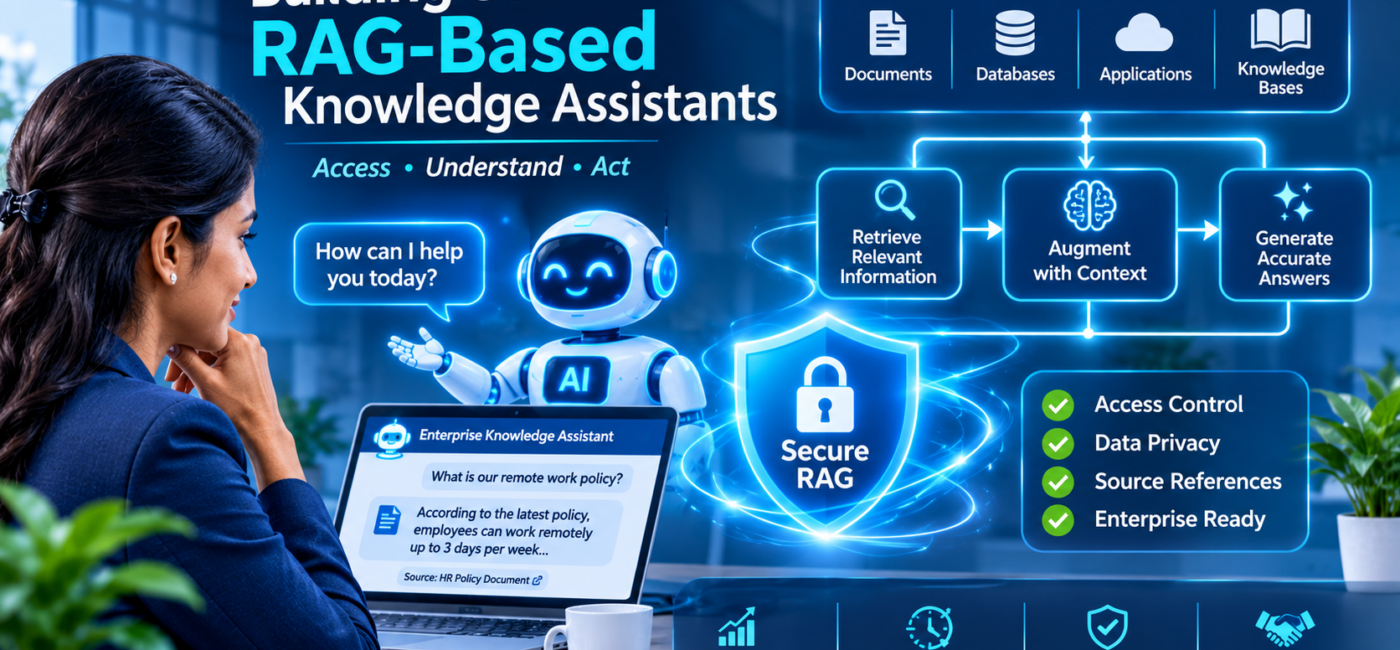
A typical RAG workflow includes:
- User Query: An employee asks a question in natural language.
- Information Retrieval: The system searches relevant enterprise knowledge sources.
- Context Preparation: Relevant information is selected and provided to the AI model.
- Response Generation: The model generates an answer based on the retrieved context.
- Source References: The system can provide references to supporting documents where implemented.
This approach helps organizations make enterprise information more accessible while keeping responses connected to relevant knowledge sources.
2. Why Enterprises Need Knowledge Assistants
Employees frequently spend time searching across multiple systems to locate policies, technical documentation, operational procedures, and business information.
A secure enterprise knowledge assistant can help address these challenges.
Potential applications include:
Employee Knowledge Support: Help employees find internal policies, HR documentation, and approved organizational information.
Technical Documentation Search: Assist engineering teams in locating technical guides, product documentation, and troubleshooting information.
Customer Support Assistance: Help support teams retrieve relevant product information, service documentation, and approved responses.
Enterprise Operations: Make standard operating procedures and internal process documentation easier to access.
Business Research: Help teams retrieve relevant information from approved reports and knowledge repositories.
The objective is to improve information discovery while maintaining appropriate access to enterprise knowledge.
3. Understanding the Architecture of a RAG System
A reliable RAG solution requires several connected components.
Enterprise Data Sources
Information may come from approved documents, internal knowledge bases, databases, and enterprise applications.
Document Processing
Documents are extracted, cleaned, divided into manageable sections, and prepared for indexing.
Embedding Generation
Text sections are converted into numerical representations called embeddings. These help the system identify semantically relevant information.
Vector Database or Search Index
The prepared information is stored in a searchable index that supports relevant content retrieval.
Retrieval Layer
When a user asks a question, the system searches for relevant information using semantic search, keyword search, or a combination of both.
Large Language Model
The retrieved information is provided as context to the language model, which generates a response based on the available content.
Security and Access Controls
Authentication, authorization, document-level permissions, and monitoring help ensure that users access only information they are permitted to see.
4. Security Considerations for Enterprise RAG
Security must be built into the RAG architecture rather than added after implementation.
Important considerations include:
Role-Based Access Control: Restrict access according to user roles and organizational permissions.
Document-Level Permissions: Ensure that retrieved content respects the access permissions of the original documents.
Data Privacy: Protect sensitive business information throughout document processing, storage, retrieval, and response generation.
Secure Integrations: Use authenticated and authorized connections when accessing enterprise applications and data sources.
Audit Logging: Maintain appropriate records of access, retrieval activity, and system interactions.
Data Lifecycle Management: Establish processes for updating, removing, and managing outdated or restricted information.
A critical requirement is that the retrieval layer must enforce permissions before restricted content is passed to the language model.
5. Improving Accuracy and Response Quality
A RAG system is only as useful as the quality of its information and retrieval process.
Organizations should consider several practices to improve response reliability.
- Maintain accurate and up-to-date knowledge sources.
- Use appropriate document chunking strategies.
- Select suitable embedding and retrieval methods.
- Apply metadata filtering where required.
- Evaluate retrieval relevance and response quality.
- Provide source references to support verification.
- Define fallback behavior when relevant information is unavailable.
RAG systems should also be tested against realistic enterprise questions to identify incorrect retrieval, incomplete answers, and unsupported responses.
6. Human Oversight and AI Governance
Even well-designed RAG systems may generate incomplete or inaccurate responses.
Enterprise implementations should therefore include appropriate governance measures.
These may include:
- Clear boundaries for permitted use cases.
- Human review for sensitive business decisions.
- Monitoring of response quality and system behavior.
- Evaluation against defined accuracy and security criteria.
- Protection against prompt injection and malicious document content.
- Procedures for reporting and correcting incorrect responses.
Human oversight is particularly important when AI-generated information may influence financial, operational, regulatory, or customer-related decisions.
7. Moving from a Prototype to an Enterprise-Ready Solution
A small RAG demonstration can be built using a limited document collection. However, production implementation introduces additional requirements.
Enterprises should plan for:
Scalable Infrastructure: Support growing document collections and user demand.
Enterprise Integrations: Connect with approved document repositories, business applications, and existing identity systems.
Permission Synchronization: Keep AI retrieval permissions aligned with the original enterprise data sources.
Performance Monitoring: Track retrieval performance, response quality, availability, and system usage.
Continuous Evaluation: Regularly test the system as documents, models, and business requirements change.
A structured implementation approach helps organizations move from experimentation toward secure, maintainable knowledge solutions.
How Tritech Infosystems Supports Enterprise RAG Solutions
Tritech Infosystems focuses on enterprise AI consulting and engineering, helping organizations explore practical AI solutions aligned with their business and technology requirements.
Our capabilities include:
Generative AI Development: Engineering intelligent assistants and enterprise AI applications.
RAG & Knowledge Systems: Designing solutions for retrieval and reasoning over approved enterprise information.
Enterprise Integration: Connecting AI applications with business systems, APIs, and enterprise platforms.
AI Governance & Guardrails: Supporting secure and responsible AI implementation through appropriate controls and evaluation.
Application & Cloud Engineering: Building the technology foundations required to support enterprise AI solutions.
By combining AI engineering with enterprise technology expertise, Tritech helps organizations approach knowledge automation with security, integration, and scalability in mind.
Conclusion
RAG-based knowledge assistants provide enterprises with a practical way to make internal information more accessible through Generative AI.
However, successful implementation requires more than connecting a language model to a document collection. Organizations must consider data quality, retrieval accuracy, access permissions, security, governance, and ongoing evaluation.
With the right architecture and engineering approach, enterprises can build knowledge assistants that support employees while respecting organizational data controls.
Ready to Explore Enterprise AI Knowledge Solutions?
Tritech Infosystems can help your organization evaluate RAG architectures and explore secure enterprise AI implementations.
Let’s Talk About Your Next AI Initiative.
Visit our Contact Us page to start a conversation.