
Category: Agentic AI
Excerpt: Traditional chatbots respond to questions, but Agentic AI goes further by understanding goals, planning tasks, interacting with enterprise systems, and executing multi-step workflows. Discover how enterprises can move beyond conversational AI toward intelligent business operations.
Introduction
Artificial Intelligence has transformed how businesses interact with technology. From customer support chatbots to AI-powered assistants, organizations are increasingly adopting conversational AI to improve productivity and enhance customer experiences.
However, traditional chatbots have limitations. They primarily respond to user queries based on predefined rules, available knowledge, or language model capabilities. While useful for answering questions, they often cannot independently complete complex business processes or take meaningful actions across enterprise systems.
This is where Agentic AI introduces a significant shift.
Rather than simply responding to prompts, Agentic AI systems can understand objectives, plan actions, use tools, retrieve information, interact with enterprise applications, and coordinate multi-step workflows.
For enterprises looking beyond basic AI assistants, Agentic AI represents an opportunity to transform how work gets done.
What Is Agentic AI?
Agentic AI refers to AI systems designed to pursue defined goals by reasoning through tasks, selecting appropriate actions, interacting with tools, and adapting their approach based on available information and results.
Unlike traditional conversational systems, AI agents can perform tasks across multiple steps while maintaining context and working toward a specific objective.
An enterprise AI agent may be capable of:
Understanding business requests and objectives.
Retrieving information from approved enterprise knowledge sources.
Breaking complex tasks into smaller actionable steps.
Interacting with business applications and APIs.
Coordinating activities across multiple systems.
Requesting human approval for sensitive actions.
Monitoring execution and reporting results.
These capabilities enable organizations to move from AI-assisted conversations toward AI-supported business execution.
Traditional Chatbots vs. Agentic AI
Traditional chatbots and Agentic AI serve different purposes.
Traditional Chatbots
Traditional chatbots are primarily designed to answer questions and support structured conversations. They can provide information, guide users through predefined processes, and respond to frequently asked questions.
Their capabilities are generally focused on conversational interaction rather than completing complex workflows.
Agentic AI Systems
Agentic AI systems can work toward defined objectives by combining reasoning, planning, enterprise data access, and tool execution.
For example, instead of simply explaining an order status, an appropriately integrated AI agent could retrieve order information, check delivery details, identify exceptions, and initiate an approved follow-up workflow.
The key difference is the shift from answering questions to coordinating actions.
Enterprise Use Cases for Agentic AI
Agentic AI can support a wide range of enterprise workflows when implemented with appropriate integrations, permissions, and oversight.
1. Customer Support Automation
AI agents can assist customer support teams by retrieving customer information, checking order details, reviewing support history, and preparing responses.
They can also classify requests, update connected systems, and escalate complex cases to human representatives.
2. Sales and Business Operations
Sales-focused AI agents can support lead qualification, research, CRM data enrichment, and preparation of personalized customer communications.
By connecting with approved business systems, these agents can help reduce repetitive administrative work and support sales teams.
3. Finance and Procurement Workflows
Agentic AI can assist with invoice processing, document verification, procurement requests, and information reconciliation.
For sensitive financial operations, human approvals and appropriate access controls should remain part of the workflow.
4. IT Operations and Enterprise Support
AI agents can help technical teams retrieve incident knowledge, analyze relevant documentation, summarize system information, and coordinate approved support activities.
This can improve access to organizational knowledge and reduce repetitive manual investigation.
5. Enterprise Knowledge Management
Organizations often maintain information across documents, databases, applications, and internal knowledge repositories.
Agentic AI systems integrated with Retrieval-Augmented Generation (RAG) can retrieve relevant information and help employees complete knowledge-intensive tasks more efficiently.
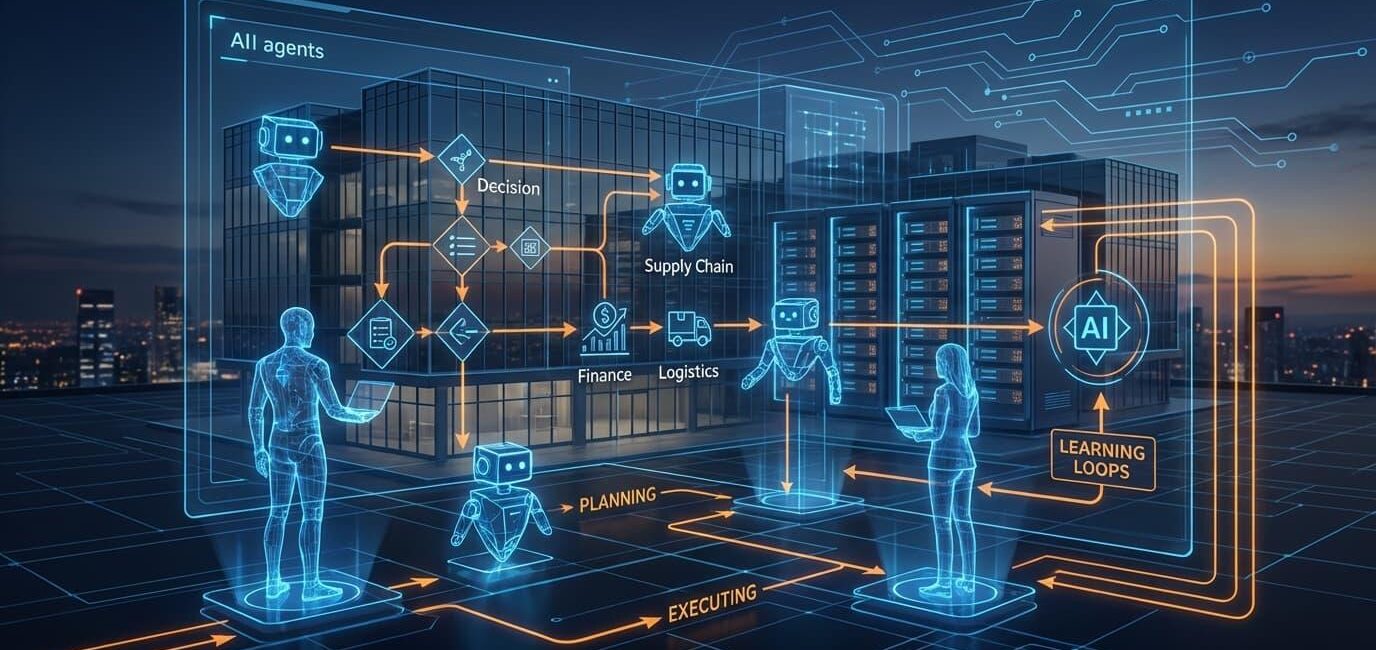
How Agentic AI Works in an Enterprise Environment
A typical enterprise Agentic AI workflow involves several connected components.
1. User Request
A business user provides an objective, instruction, or request.
2. AI Orchestration
An AI orchestrator interprets the request, determines the required steps, and coordinates the relevant agents or tools.
3. Specialized AI Agents
Different agents may handle specific responsibilities such as research, document processing, data retrieval, or workflow execution.
4. Enterprise Data and Systems
Agents interact with approved enterprise applications, databases, APIs, and knowledge sources.
5. Human Approval
Sensitive or high-impact actions can be routed for human review and authorization.
6. Business Action
Once authorized, the workflow executes the appropriate action and provides the user with an outcome or status update.
This architecture allows organizations to connect AI capabilities with existing enterprise processes rather than treating AI as an isolated application.
Challenges Enterprises Should Consider
Despite its potential, implementing Agentic AI requires careful planning and engineering.
Enterprise Integration
AI agents must interact reliably with existing applications, APIs, databases, and business workflows.
Data Security and Access Control
Agents should access only the information and systems they are authorized to use. Enterprise identity, permissions, and data protection policies must be considered.
Governance and Human Oversight
Organizations need clear policies defining which actions agents can perform independently and which require human approval.
Reliability and Evaluation
Agent performance should be evaluated through testing, monitoring, observability, and continuous improvement.
Scalability and Operational Readiness
Solutions must be designed to handle enterprise workloads, integration complexity, and changing business requirements.
Moving from AI Experiments to Enterprise Implementation
Successful Agentic AI adoption is not simply about deploying an advanced language model. It requires understanding business processes, identifying suitable automation opportunities, designing the right architecture, and integrating AI into enterprise environments.
Organizations should begin by identifying workflows with repetitive tasks, clear business objectives, accessible data, and measurable operational requirements.
A structured implementation approach can help enterprises move from initial experimentation toward reliable production solutions.
How Tritech Infosystems Supports Enterprise AI Initiatives
At Tritech Infosystems, we focus on combining enterprise technology experience with AI-driven engineering to help organizations modernize operations and build intelligent business capabilities.
Our AI and technology capabilities include:
Agentic AI Development: Designing intelligent agents and multi-agent workflows for enterprise use cases.
Generative AI and RAG: Building enterprise assistants connected to relevant knowledge sources.
Enterprise Integration: Connecting AI solutions with business applications, APIs, and enterprise platforms.
AI Process Automation: Engineering intelligent workflows that support business process execution.
AI Governance and Guardrails: Incorporating security, access controls, oversight, and evaluation into AI implementations.
We help organizations explore practical AI opportunities and develop solutions aligned with their technology environments and business objectives.
Conclusion
The evolution from traditional chatbots to Agentic AI represents an important development in enterprise technology.
While chatbots make information more accessible, Agentic AI creates opportunities to coordinate tasks, connect systems, and support complex business workflows.
For enterprises, the opportunity lies in applying these capabilities responsibly, with strong engineering foundations, secure integrations, and appropriate human oversight.
The next phase of enterprise AI is not just about building systems that can answer questions. It is about building intelligent systems that can help organizations get work done.
Ready to explore Agentic AI for your organization?
Connect with Tritech Infosystems to discuss your enterprise AI opportunities, solution architecture, and implementation roadmap.
CTA: Schedule an AI Consultation